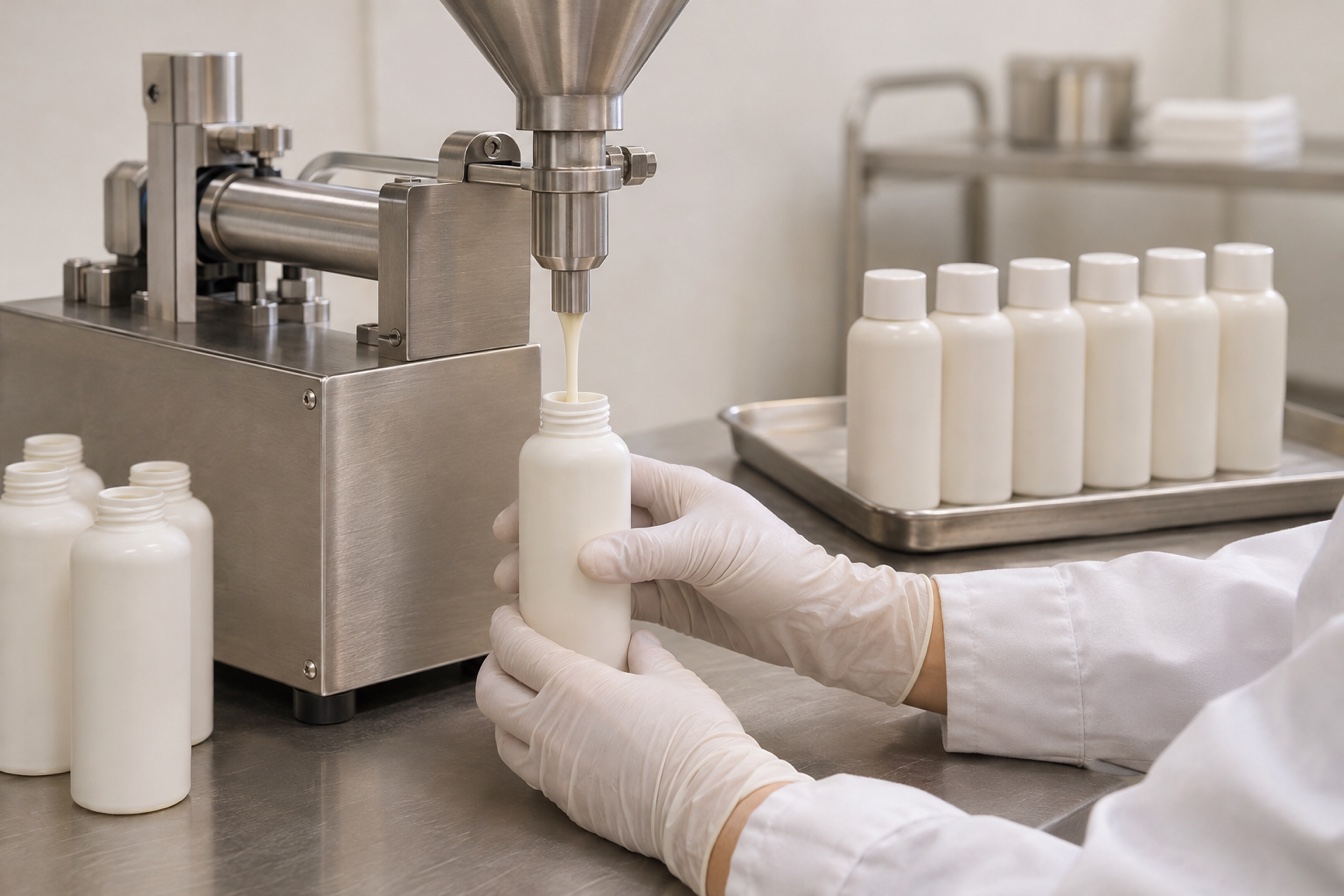
AI-generated image.
If you launch your own beauty brand with a first run of 1,000 units, what you give up is mostly looks and range, and what you must keep is what is inside and who is responsible for it. A custom-designed bottle, several products at once, a launch date fixed in advance and an instant restock after a sell-out usually have to be dropped or re-sequenced at that volume. The fit between formula and packaging, the person legally responsible for selling, quality testing on every production run and the claims in your videos and posts stay exactly the same at any quantity.
This article is for creators with an audience who want to put their name on a product. It takes four common creator wishes, sets them against what a 1,000-unit run allows, and then lists four things that do not shrink with quantity. EVAS's own production terms are used as a worked example. Where the minimum comes from is covered on our small batch page, and the legal duties that do not get smaller with volume are in our MOQ article.
Can a Korean manufacturer really make just 1,000 units?
Yes. EVAS produces from 1,000 units. That figure refers to the product itself, though: the quantity you can actually order depends on the minimums for packaging components such as bottles, tubes, labels and printing.
Packaging has its own typical quantities at which the supply price becomes reasonable: usually 10,000 units for bottles and tubes, and 5,000 for applied labels. These are not minimums but the volumes where the unit price settles, and they vary with the component spec. So in a first inquiry, "With this bottle and this way of labeling, what changes at 1,000 units?" gets you a more useful answer than "What is your MOQ?"
Check the category too. EVAS makes skincare, hair care and body care in-house, including sun care and functional cosmetics. Sheet masks and makeup are not made in-house; we handle them as ODM consulting. If your first product is a color cosmetic, raise that difference in the first conversation.
Give up #1: Will my first 1,000 units come in a custom bottle?
Usually not; most first runs use a stock bottle. Small test runs typically choose from pre-molded stock containers in basic black or white, and the unit price for these is set higher. Products where the packaging spec and design matter push the packaging minimum up to lots of 10,000.
For a creator, the bottle is the first thing people see on screen, so this one is hard to let go. A realistic order is to carry your brand recognition on the label and on the product itself (color, scent, texture) in the first run, and to revisit a custom bottle once reorder volumes become visible.
Printing needs the same math. Printing carries a base cost that does not depend on quantity, so cutting the quantity does not cut the total by the same amount, and the per-unit price rises sharply. With hypothetical numbers for illustration only: printing that costs KRW 40 per unit (KRW 400,000 in total) at 10,000 units can become KRW 250 per unit (KRW 250,000 in total) at 1,000 units. Actual amounts come from a quote for your spec.
Give up #2: Can I launch several products at once?
You can, but at 1,000 units every extra product adds to the burden, because a large share of what a production run costs does not depend on quantity. Starting with one hero product and adding more once you see the response is easier to plan.
Whether you make 1,000 or 5,000 units, the manufacturing cost and the pre- and post-production work cost the same; only the filling cost and the cost of the formula itself change with quantity. Split the same 1,000 units across three products and those costs can arise for each product separately. Ask for a quote that shows which costs attach to each product (comparing quotes).
There is a structure worth keeping in mind for when you add products: several products share one bottle and differ only by label. For example, you buy 10,000 bottles at once at an efficient price, prepare three labels at 5,000 each (labels cost less), and produce three products at 3,000, 3,000 and 4,000 units. This is not a first-1,000-units method; it is a reason to ask, when you pick your first bottle, whether a second product could use it too.
Give up #3: Can I announce the launch date now?
It is safer not to until the packaging arrival date is confirmed. At EVAS, formula development usually takes 2 to 4 weeks, and up to 12 weeks for special formulas; production takes 8 weeks after the packaging arrives. The time to make and deliver the packaging is not included in those figures.
Content calendars usually start from a date, but a manufacturing schedule starts from the day the packaging arrives. So we suggest announcing in two steps. When the sample is approved, say only that something is in the works. Once the packaging arrival date is fixed, add the 8 weeks of production to it and set the launch date. Do not promise a date built by roughly adding the stages together. The stages and what stretches them are in our lead time article.
Give up #4: If it sells out, how fast can I restock?
How fast you can restock depends on how you bought packaging for the first run. There are two ways to match packaging to a 1,000-unit run: buy the packaging at its minimum quantity up front and produce in 1,000-unit runs, or buy packaging for just 1,000 units at a higher unit price.
Scroll horizontally to see all columns when the table is wider than your screen.
| Buy packaging at its minimum up front | Buy packaging for 1,000 units | |
|---|---|---|
| Upfront packaging spend | Higher | Lower |
| Packaging unit price | Close to the efficient price | Higher |
| Packaging at restock | Already in stock | Reorder and wait for delivery |
| If you want to change the design | Leftover packaging is a cost | Easy to change from the next run |
Either way, production still runs 8 weeks after the packaging arrives. For a first run where demand is still uncertain, buying for 1,000 units is worth considering first; when reorders are close to certain and you do not plan to change the bottle design, buying up front is worth considering first. Whichever you choose, quality testing comes with every run, as covered under "Keep #3" below.
What must I keep no matter the quantity?
Quantity lets you save on looks and range. The four items below are the same whether you make 100 units or 10,000. A check skipped in the first run can come back later as a delay.
Keep #1: The formula and the packaging have to fit
Even with a stock bottle, you still need to confirm that the formula works with that packaging (viscosity and the pump, ingredients and the container material). Switching to a stock bottle is a way to cut cost, not a way to skip that check. What to check and when is in our packaging compatibility article.
Keep #2: Someone legally responsible for selling
To distribute and sell cosmetics in Korea, a cosmetics responsible seller registration is required. Article 3(1) of Korea's Cosmetics Act requires anyone who intends to run a cosmetics manufacturing business or a cosmetics responsible selling business to register with the Minister of Food and Drug Safety, and Article 3(3) requires a responsible seller to meet quality control and post-market safety management standards and to appoint a responsible sales manager.
Outsourcing manufacturing does not leave that role empty. Whether you register yourself or work with a company that is already registered is covered in our articles on business registration and on what the brand owner still has to do. If you sell outside Korea, check that market's own rules on who carries this responsibility; this article does not cover them.
Keep #3: Quality testing on every production run
Article 12(5) of the Enforcement Rule of the Cosmetics Act requires a responsible seller to put products on the market only after thorough quality testing for each batch number. The testing may be skipped where the manufacturer and the responsible seller are the same business, or where testing was outsourced to a designated body and a test result exists for each batch number.
If you restock in 1,000-unit runs, each run gets its own batch number, and the rule applies to each run. Build that testing time into your restock schedule. What a test report should cover is in our batch release testing article.
Keep #4: The claims in your videos and posts
Article 2(9) of the Cosmetics Act defines advertising as presenting or announcing information about a cosmetic product through radio, television, newspapers, magazines, voice, sound, video, the internet, printed matter, signboards or any other means. Product videos and posts that a brand owner publishes on their own channels can fall within that definition.
Article 13(1) of the same Act bars a business operator or seller from labeling or advertising that may be mistaken for a medicine, that may make a product that is not a functional cosmetic (a regulated category in Korea) look like one, or that may otherwise mislead consumers or differ from the facts. Even if you are describing your own experience with the product, check the wording before you post. What you need to back a claim is in our claim substantiation article, and the disclosure rules for when other creators review your product are in our sponsored review article. These are Korean rules; other markets have their own.
What should I send in the first inquiry?
Send the eight points below and we can tell you straight away what is possible at 1,000 units and what changes. Anything you have not decided can be marked "not decided yet".
- One hero product and its volume
- First-run quantity and when you expect to reorder
- Bottle direction: a stock (pre-molded) container or a custom design
- Labeling: an applied label or printing on the container
- Packaging purchase: buy at the minimum up front, or buy for 1,000 units
- Countries and channels you will sell in
- The launch timing you would like (not a date you have already announced)
- A reference product close to the texture or scent you want
EVAS handles planning, formulation research, production, packaging and logistics in-house, so quantity and packaging can be adjusted together in one place. See how a project runs on our process page and in the development guide, and the scope of our work on our OEM/ODM services page. Our formula library can also help you set a direction; its entries are development concepts, not finished products ready to produce. When you are ready, send it through a development inquiry.
What this article does not cover
- There are no unit prices or total costs here. They depend on the product, packaging and labeling, and come from a quote. The printing figures above are hypothetical numbers for illustration.
- Registration, labeling and responsible-person rules in markets outside Korea are not covered.
- Rights to the formula and technical data are covered separately in who owns the formula.
- The provisions cited were checked on the Korea Law Information Center on 26 November 2026: the Cosmetics Act as Act No. 22113 (in force 20 October 2026) and its Enforcement Rule as Ordinance No. 2109 (in force 2 April 2026). This is not legal advice on any specific case.