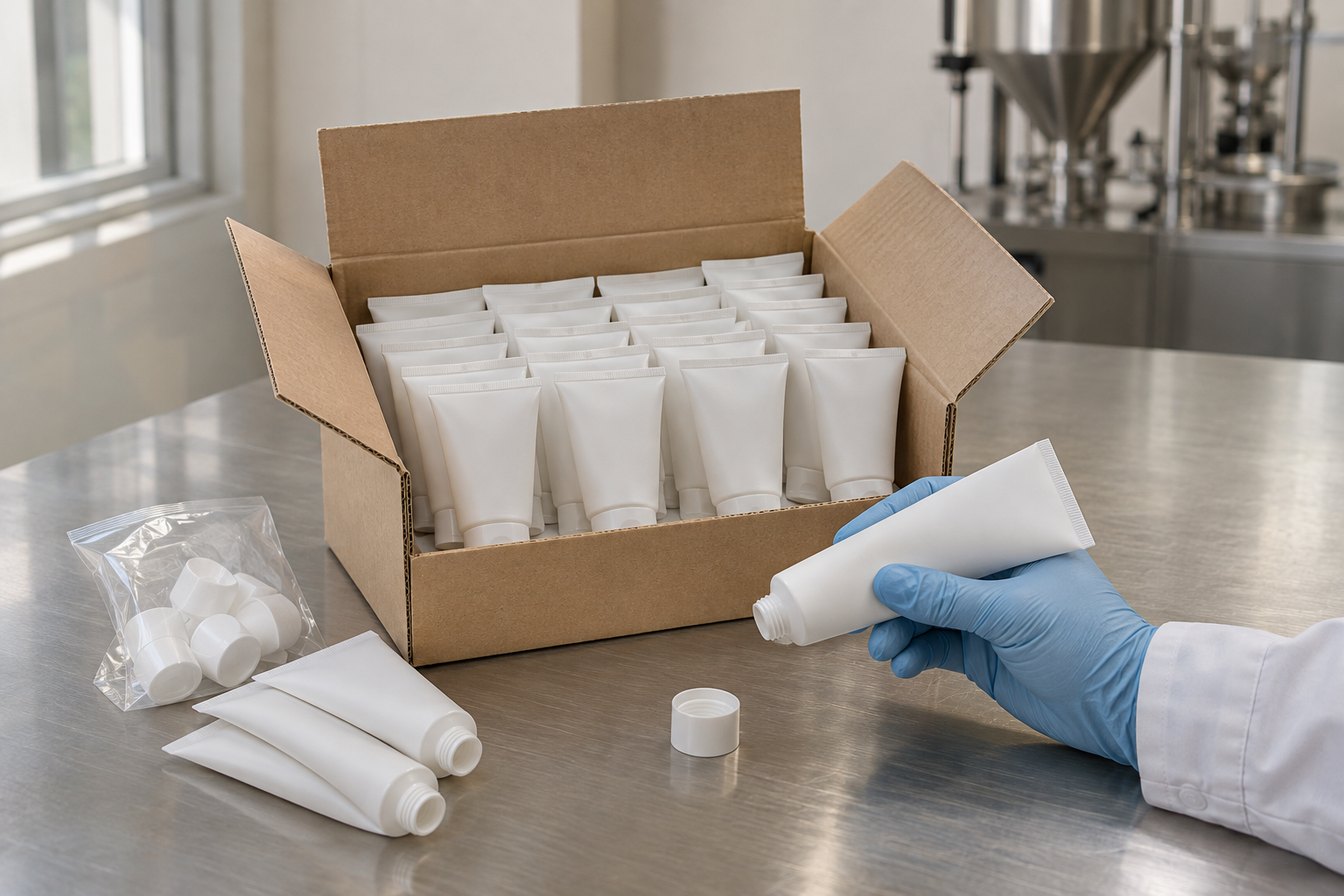
AI-generated image.
The short answer: 2 to 4 weeks to develop the formula, then 8 weeks of production once packaging arrives
At EVAS, formula development usually takes 2 to 4 weeks. A special formula with a difficult sample can take up to 12 weeks. Production takes 8 weeks, counted from the day the packaging components (bottles, tubes, labels) arrive at the factory.
The part buyers most often miss is packaging. The time it takes to make and deliver your bottles, tubes and labels is not included in those numbers, and it depends on the specification and the supplier. So "8 weeks after I place the order" is the wrong way to plan. This article explains when each clock starts and stops, what makes each one longer, and what to put in your first inquiry so the schedule can be fixed quickly.
1. Plan with three clocks, not one
From development to delivery is not a single timeline. It is three periods that start at different points.
Scroll horizontally to see all columns when the table is wider than your screen.
| Stage | Starts when | Ends when | EVAS typical time | What makes it longer |
|---|---|---|---|---|
| Formula development | You and EVAS agree on the direction and the brief | The sample (and so the formula) is approved | Usually 2-4 weeks; up to 12 weeks for a special formula | Sample difficulty, number of revision rounds |
| Packaging | Bottle, tube and label specs are fixed | Components arrive at the factory | Depends on spec and supplier (confirmed in consultation) | Custom design, print setup, spec changes |
| Production | Packaging arrives | Production is complete | 8 weeks after packaging arrives | Late packaging |
These are the typical periods EVAS quotes in consultation. They vary by product and conditions, and this article does not promise a single total lead time, because the total cannot be calculated until the packaging period is known.
2. What decides 2 to 4 weeks versus 12 weeks of development?
The difficulty of the sample. A typical product reaches an approved formula in 2 to 4 weeks; a special formula that is harder to get right can take up to 12 weeks. The same product type can be easy or hard depending on what you require of it, so EVAS gives a development estimate after seeing your reference product and requirements.
Here is what you can control:
- Send your reference product and your non-negotiables up front. Say what you like about the reference, what you want changed, and which ingredients must stay out. The first sample lands closer to the target.
- Consolidate feedback. Comments that arrive from different people at different times add revision rounds. How to compare samples under the same conditions and write usable feedback is covered in Formulation Sample Feedback: How to Write It and When to Lock the Formula.
- Decide whether to start from an existing formula. Starting from a concept in the formula library or an existing base is a different scope of work from designing a new formula. See Base Formula vs Custom Formulation.
3. When does the 8-week production clock start?
On the day your packaging arrives at the factory. Even if the bulk is ready, filling and packing cannot start without the bottles, tubes and labels. So the first date to pin down in a real schedule is the packaging arrival date.
The packaging period is decided by the spec. Products where the packaging spec and design matter usually move to minimums in units of 10,000. For a small test run, buyers often choose from stock (pre-molded) containers in black or white, which carry a higher unit cost. Decide the container together with the formula, not after the artwork is finished. When to check that the container and the formula are compatible is covered in Cosmetic Packaging Compatibility: When to Lock the Container.
Quantity matters too. EVAS can produce from 1,000 units, but the real minimum depends on the minimum order quantities of the packaging components, such as bottles, tubes, labels and printing. Ways to line those up are on the small-batch production page.
4. What do a functional claim and a shelf-life date add to the schedule?
Both sit outside the 8 weeks of production and need their own preparation. They are tied to the moment the formula is locked, so put them in the plan at the start of development.
- Functional cosmetics (for sale in Korea). To sell a product in Korea with a function defined by law, such as skin brightening, wrinkle improvement or UV protection, the product must pass a review or be covered by a filed report, item by item (Cosmetics Act, Article 4(1)). A functional cosmetic without that review or report may not be sold, or made or stored for sale (Article 15(1)). A product that matches the notified active ingredients and concentrations can take the report route; otherwise a review with safety and efficacy data is needed (Enforcement Rule, Articles 9(1) and 10(1)). A review means preparing a dossier and waiting for it to be examined, so schedule it separately from manufacturing. Which route applies is explained in Brightening and Anti-Wrinkle Serums in Korea: When a Report Is Enough and When a Review Is Required. If you sell only outside Korea, the rules of the destination country apply instead.
- Shelf life and period after opening. These dates come from stability evaluation. The MFDS Guidelines on Stability Testing of Cosmetic Products (Guidance No. 0332-01) say long-term and accelerated tests should in principle run for 6 months or more, while allowing the period to be set or adjusted to the product. The guidance is not legally binding, and which tests to run and by when is decided product by product. A change of formula or container restarts the evaluation, which is why late changes to either have the biggest effect on the schedule. The evidence behind these dates is covered in Shelf Life and Period After Opening.
5. What should your first inquiry include to get a firm schedule faster?
Product type and reference product, any functional claim, packaging direction, quantity, target launch date, and the countries where you will sell. With these six points, the first consultation can show which of the three clocks is likely to run long.
- Product type and reference: serum, shampoo, body wash and so on, plus what you like and want changed in the reference.
- Functional claim: whether you plan a brightening, anti-wrinkle or UV claim, or no functional claim.
- Packaging direction: stock containers or a custom design.
- Quantity: first production run and number of SKUs.
- Target launch date: EVAS counts back from it to show which stage is tight.
- Markets and channels: Korea, export, or both. Registration steps differ by country and are checked separately.
EVAS manufactures skincare, hair care and body care products in-house, and runs planning, development research, production, packing and logistics itself. What gets decided at each stage is laid out on the development process page and in the development guide. When you are ready, send a product development inquiry.
FAQ
If I place an order, will I have the product 8 weeks later?
No. Eight weeks is the production time after the packaging arrives at the factory. Making and delivering the packaging takes its own time depending on the spec and supplier, and formula development comes before that.
Can you confirm the total lead time from the start?
Only once the packaging spec and any functional-cosmetic route are decided. In the first consultation, EVAS separates what is already fixed from what is still open for each of the three periods.
What counts as a special formula?
Development time depends on how difficult the sample is, and a difficult formula can take up to 12 weeks. EVAS tells you which side your product is likely to fall on after reviewing your reference product and requirements.
Does the lead time include shipping overseas?
No. These periods cover development and production only. Freight, customs clearance in the importing country and any registration in your market need to be planned separately.
Sources
- Cosmetics Act of Korea (Act No. 22113, in force 2026-10-20), Articles 4(1) and 15(1). Korea Law Information Center.
- Enforcement Rule of the Cosmetics Act (Prime Ministerial Decree No. 2109, in force 2026-04-02), Articles 9(1) and 10(1). Korea Law Information Center.
- Ministry of Food and Drug Safety, Guidelines on Stability Testing of Cosmetic Products (Guidance No. 0332-01). Non-binding guidance.
- EVAS development and production periods, product scope and minimum quantity were confirmed by the company on 22 November 2026. Actual schedules are confirmed in consultation for each product.
Sources
- Cosmetics Act of Korea, Articles 4(1) and 15(1), Act No. 22113, in force 2026-10-20 (Korea Law Information Center) (accessed 2026-11-23) ↗
- Enforcement Rule of the Cosmetics Act, Articles 9(1) and 10(1), Prime Ministerial Decree No. 2109, in force 2026-04-02 (Korea Law Information Center) (accessed 2026-11-23) ↗
- Ministry of Food and Drug Safety, Guidelines on Stability Testing of Cosmetic Products (non-binding guidance), Guidance No. 0332-01 (accessed 2026-11-23) ↗