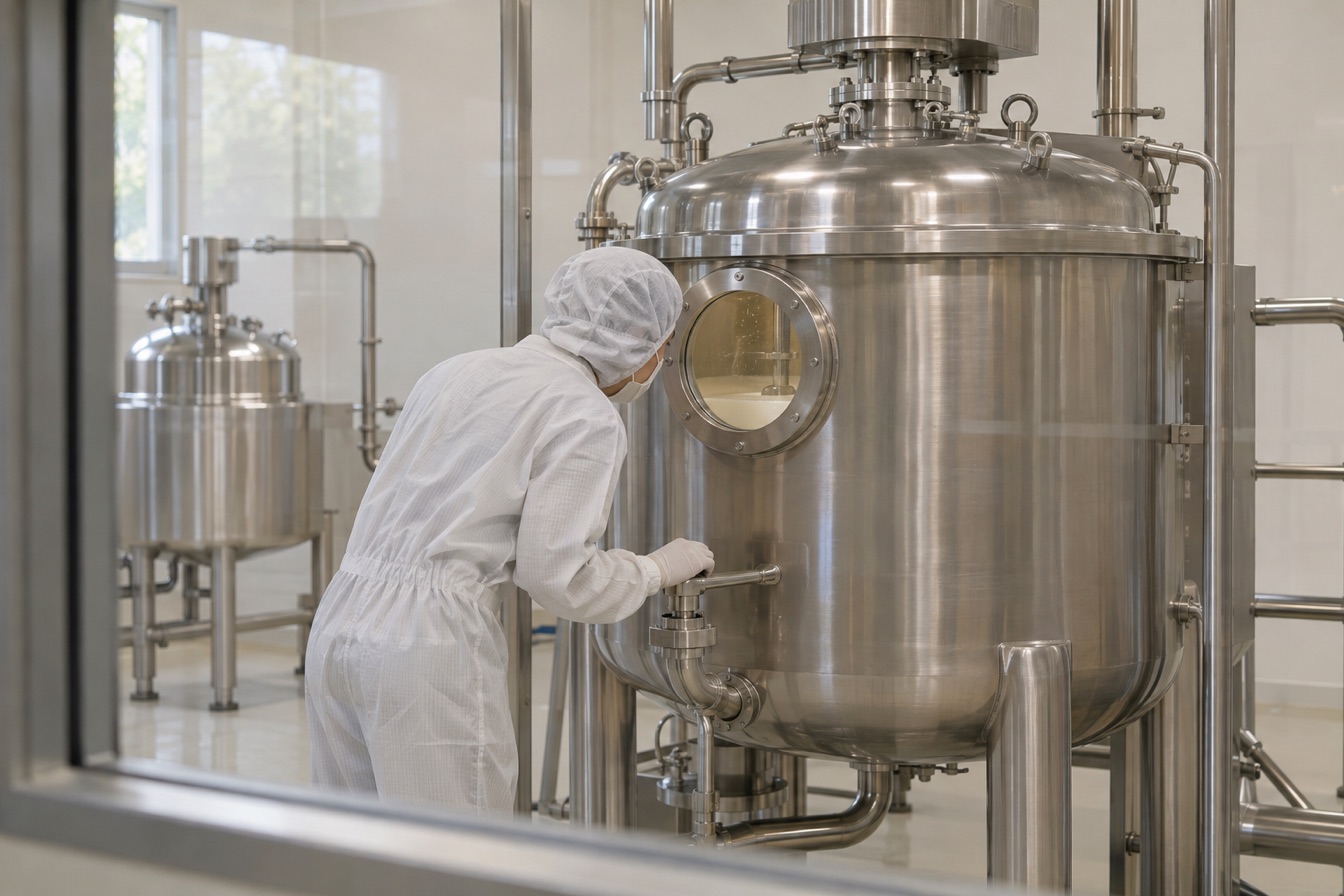
AI-generated image.
The short answer: before you ask for a price, get in writing what they do themselves and under what conditions
A quote only means something once you know which steps the manufacturer handles in-house, whether your product category is actually made in their own plant, and what conditions sit behind the quantity and timeline they give you. So ask the seven questions below before you ask for unit prices, and get the answers in writing. That way you compare manufacturers on the same basis. A useful answer never stops at "yes, we can": it states the scope, the conditions, and who did the assessing.
This article is about shortlisting a manufacturer. Once quotes come in, our guide to comparing manufacturing quotes shows how to line up what each one includes. Under each question we also give EVAS's own answer. The point is not to compare ourselves with anyone else, but to show how specific an answer should be.
The seven questions at a glance
Scroll horizontally to see all columns when the table is wider than your screen.
| Question | What a good answer includes | EVAS's answer |
|---|---|---|
| 1. Which steps do you do yourselves? | In-house vs partner, step by step | Planning, R&D, production, packaging and logistics in-house |
| 2. Do you make my category in your own plant? | In-house or not, per category | Skincare, hair, body, sun care and functional products in-house; sheet masks and makeup through ODM consulting |
| 3. Registration and quality system? | The registration held; who certified what, and the scope | ISO 22716 and ISO 9001 certified |
| 4. What is your minimum? | The number and what drives it | From 1,000 units, depending on packaging minimums |
| 5. How long does it take? | Time per stage, and when each clock starts | Formula development 2-4 weeks (up to 12 for special formulas); production 8 weeks after packaging arrives |
| 6. Who owns the formula? | Ownership and data terms for the contract | Confirmed as contract terms in consultation |
| 7. Have you handled my market's registration? | The procedure by name, and the manufacturer's part in it | Experience with procedures for the EU, US, China, Japan, Vietnam and Malaysia |
1. From development to shipping, which steps do you handle yourselves?
Ask, step by step, what they do in-house and what goes to a partner. "One-stop" can mean one company running every step, or one company coordinating several others. Neither is wrong, but it changes who you align schedules and responsibilities with.
The steps worth asking about are product planning, container and carton design, formulation, bulk manufacturing, filling and packing, quality testing, and storage and dispatch. Korean law is built around the same split. Article 2(10) of the Cosmetics Act defines a cosmetics manufacturing business as one that manufactures "all or part" of a cosmetic (secondary packaging or labeling alone does not count), and Article 3(2) lets a manufacturer that handles only some processes register without some of the facilities. So the word "manufacturer" alone does not tell you the company runs every process.
EVAS's answer: We handle planning, R&D, production, packaging and logistics ourselves, along with design and brand content. Because the steps stay inside one company, we can also support small production runs. The order of work is laid out on our process page.
2. Is my product category made in your own plant?
Ask about your category, not the company as a whole. A manufacturer may make some categories itself and send others to a partner plant. If the category is made in-house, formula changes and production scheduling are handled in one place; if not, you need to know where it is really made.
EVAS's answer: We manufacture all skincare, hair care and body care products ourselves, as well as sun care and functional cosmetics. We do not manufacture sheet masks or makeup; those run as ODM consulting projects. You can see products made for EVAS's own brands, by category, on our skincare, hair care and body care pages.
3. Who assessed your registration and quality system?
To manufacture cosmetics in Korea, a company must register as a cosmetics manufacturer with the Ministry of Food and Drug Safety (MFDS) under Article 3(1) of the Cosmetics Act. CGMP conformity and ISO certification sit on top of that registration, so ask separately what was assessed, by whom, and how far it reaches.
Manufacturer registration comes with facility requirements: a production area, storage, a testing laboratory and quality-testing equipment (Enforcement Rule of the Cosmetics Act, Article 6(1)). A manufacturer that runs only some processes, or that outsources quality testing to bodies such as a public health and environment research institute or a designated cosmetics testing laboratory, may go without some of these (Article 6(2)). That makes "Do you run quality testing yourselves, and if not, who does it?" a fair question too. What MFDS CGMP conformity proves and does not prove is covered clause by clause in our CGMP article. The registration your own brand needs to sell in Korea is covered in our business registration article.
EVAS's answer: We hold ISO 22716 (cosmetics good manufacturing practices) and ISO 9001 (quality management systems) certification. ISO certification and MFDS CGMP conformity are different schemes, so whichever manufacturer you are talking to, do not read the two names as the same thing.
4. What is your minimum order, and what sets that number?
Ask what drives the number, not just the number. Even when the bulk can be made in small amounts, containers, tubes, labels and printing each come with their own minimums, so the quantity you can actually start with may be set by the packaging. "1,000 units is possible" only means something once you know which container and which printing it assumes.
EVAS's answer: Production starts from 1,000 units. The real minimum, though, depends on the minimums of packaging components such as containers, tubes, labels and printing. For products where packaging specs and design matter a lot, the minimum moves up to 10,000-unit lots. If you want to test a small run first, the usual route is a stock (pre-molded) container, which is priced higher per unit. There are two ways to match packaging to 1,000 units: buy the packaging at its minimum up front and run production in 1,000-unit batches, or buy packaging sized to 1,000 units at a higher unit price. The details are on our small-batch page and in our MOQ article.
5. How long do development and production take, and when does each clock start?
Always ask when the count starts, not only how many weeks. The same eight weeks can mean eight weeks from your purchase order, from sample approval, or from the day packaging arrives, and that changes your launch date a lot.
EVAS's answer: Formula development usually takes 2-4 weeks; a special formula with a difficult sample can take up to 12 weeks. Production takes 8 weeks once packaging components have arrived. The time to make and deliver the packaging is not included in those 8 weeks, so we confirm the full schedule once the packaging spec is fixed. What stretches each stage is covered in our development and production lead time article.
6. Who will own the formula you develop?
Ask who owns the formula, and which technical data you get and when, as items to write into the contract. A verbal answer is hard to rely on when you reorder or move to another manufacturer.
What needs settling depends on whether the formula is built from scratch or adapted from an existing base. What to put in the contract is covered in Who Owns the Formula?, and the difference between the two development routes in base formula vs custom formulation.
EVAS's answer: Ownership of the formula and technical data is not something we can set as a public rule in this article. Please confirm it as a contract term when we discuss your project.
7. Have you handled registration in the market I sell to?
Do not stop at the country name. Ask for the name of the procedure and which part of it the manufacturer handles. Registration, notification and approval work differently from country to country, and some steps must be done by the brand or a local responsible party.
Take the US. The FDA requires facilities that manufacture or process cosmetics to register, and requires products to be listed. Product listing is done by the "responsible person": the manufacturer, packer or distributor whose name appears on the label. The FDA states that registration and listing are not a cosmetic approval program and that it does not issue certificates to verify compliance. So if you hear "FDA approved" or "FDA certificate", it is worth asking what exactly that refers to. How Korean law treats products made only for export is covered in our export-only cosmetics article.
EVAS's answer: We have experience handling registration procedures for the EU (CPNP notification), the US (FDA facility registration and product listing), China, Japan, Vietnam and Malaysia. These procedures differ by country, so we do not lump them together as "certifications". Which parts we can take on for your product is confirmed once we know your target markets and category.
What should you do once you have the answers?
Put all seven answers on one page and mark each one "confirmed", "conditional" or "open". Quotes received while items are still open may rest on different assumptions, so fill the gaps first and then move on to comparing quotes.
If you contact EVAS, feel free to send these seven questions as they are. Add the product category, target quantity and pack size, and the countries and channels you plan to sell in, and the answers get more specific. What to prepare is on our development guide, the scope of what we do is on our services page, and you can send your questions through our contact page.
Frequently asked questions
Should I go with a large manufacturer or a smaller one?
Size matters less than whether the manufacturer answers these seven questions specifically for your category, quantity and timeline. Send the same questions to each candidate and set the answers side by side, looking at scope and conditions.
Do I need to decide between OEM and ODM first?
Deciding first makes the conversation shorter, but it is not a prerequisite. The route depends on whether you already have a formula or need the manufacturer to develop one; our article on finished-product sourcing vs OEM/ODM walks through that choice.
Do I really need the answers in writing?
Written answers let you check later that the same conditions made it into the quote and the contract. The conditions behind a minimum quantity, and the day a lead time starts counting, are exactly the things two people remember differently after a phone call.
Sources checked on 24 November 2026: Korea's Cosmetics Act (Act No. 22113, in force 20 October 2026), Articles 2 and 3, and its Enforcement Rule (Prime Ministerial Ordinance No. 2109, in force 2 April 2026), Article 6, via the Korea Law Information Center; and the US FDA page on registration and listing of cosmetic product facilities and products (content current as of 9 September 2026). Statements about EVAS reflect company confirmation as of 22 November 2026.
Sources
- Cosmetics Act of Korea, Articles 2(10) and 3, Act No. 22113, in force 2026-10-20 (Korea Law Information Center) (accessed 2026-11-24) ↗
- Enforcement Rule of the Cosmetics Act, Article 6, Prime Ministerial Ordinance No. 2109, in force 2026-04-02 (Korea Law Information Center) (accessed 2026-11-24) ↗
- US FDA, Registration and Listing of Cosmetic Product Facilities and Products (content current as of 2026-09-09) (accessed 2026-11-24) ↗