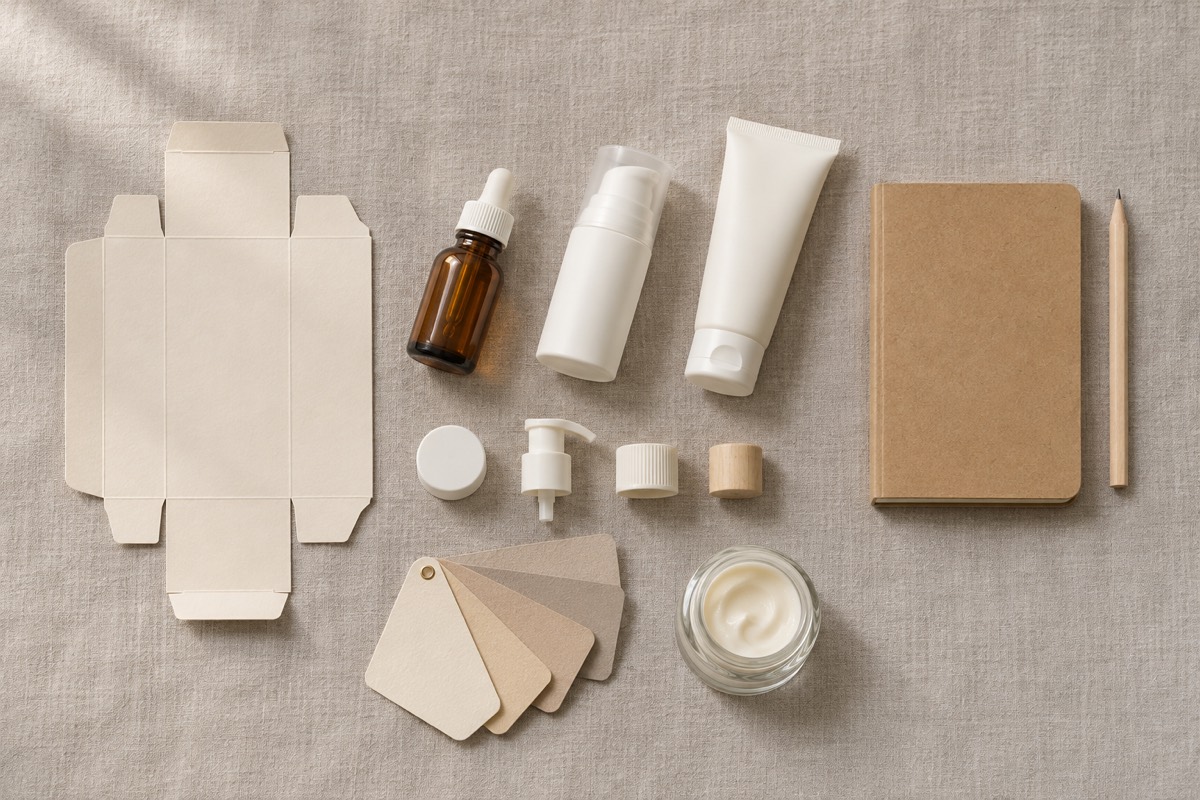
AI-generated image.
There is no single honest number for what it costs to start a skincare brand with a Korean manufacturer. The money splits into costs you pay once whatever the quantity, costs whose per-unit price rises as the quantity falls, and costs that may sit outside the manufacturer's quote, and each group is locked at a different point on the way to your first product.
That is why a budget built in order is more reliable than a budget built from a total. Instead of prices, this guide walks through the steps to a first product and shows which cost each step commits you to, what does not get smaller when you order fewer units, and what you need to budget separately from the factory quote. How to compare two quotes line by line is covered in Comparing Cosmetics Manufacturing Quotes.
Why can't anyone give you one total cost?
Because the list of cost lines itself changes with your choices: how many units, a stock bottle or a custom one, a regular cosmetic or a regulated functional product, and which country you sell in. If you start from a total, you cannot see which lines it left out.
Splitting costs into three groups shows what you can shrink and what you cannot.
- One-time costs: formulation development and samples, packaging design, print setup and other fixed charges, business registration. These stay almost the same when you order fewer units.
- Costs that change per unit with quantity: filling and processing, the bulk formula itself, and the price you pay for packaging components. The fewer units, the higher the per-unit price.
- Costs that may sit outside the manufacturer's quote: the registration and staff of whoever is legally responsible for selling, evidence for label and advertising claims, trademark and barcodes, sales channels and logistics, and, when you sell abroad, that market's registration and local responsible person. What a quote includes varies by manufacturer, so ask what is in and what is out when you request one.
In what order do you get to a first product, and what does each step lock in?
Most costs are locked before production, not at it. Once you decide who sells, which container you use and what the label says, most of the downstream cost is already set, so build your budget in the same order.
Scroll horizontally to see all columns when the table is wider than your screen.
| Step | Cost locked at this step | Type |
|---|---|---|
| 1. Decide who sells, and where | In Korea, Responsible Seller registration and a responsible manager; abroad, that market's registration and responsible person | Outside the quote, not tied to quantity |
| 2. Product brief and formulation | Sample development; for functional cosmetics, review or report data | One-time |
| 3. Container and components | Component minimums, custom vs stock container, how components are bought | Changes with quantity |
| 4. Design and label copy | Packaging design, print setup, evidence for label and ad claims | One-time + outside the quote |
| 5. Order quantity and purchase order | Filling and processing, bulk formula | Changes with quantity |
| 6. Production, testing, shipment | Batch-by-batch quality testing, packing, logistics | Every production run |
| 7. After launch | Reorders, inventory storage, annual production report (Korea) | Recurring |
Step 1: Who carries legal responsibility for selling?
If you sell in Korea, outsourcing all manufacturing does not remove the need for a Responsible Seller registration and a responsible manager (Cosmetics Act, Article 3). The responsible manager must meet set qualifications, such as a science or cosmetics-related degree or experience in cosmetics manufacturing or quality control; in a business with 10 or fewer regular employees, a qualified owner or representative can take on that role (Enforcement Rule, Article 8). Registration carries a fee set out in Annex 9 of the Enforcement Rule. The registration itself is explained in Cosmetics Business Registration in Korea.
If you sell abroad, your own market's registration or notification and a local responsible person take the same place in the budget. For the US and the EU, see Selling Korean-Made Cosmetics in the US and EU: Which Documents to Request from Your Manufacturer.
Step 2: What gets set during development?
The cost and time of sample development. At EVAS, formulation development usually takes 2 to 4 weeks, and up to 12 weeks for specialized formulas, depending on how demanding the sample is. If you want to sell a product as a functional cosmetic in Korea (for example, brightening or wrinkle care), each product needs either an MFDS review or a submitted report (Cosmetics Act, Article 4), so preparing that data belongs in the development budget. A complete brief cuts down on sample rounds: How to Write a Product Development Brief.
Step 3: What comes with your choice of container?
Packaging component minimums set your budget before your production quantity does. In the quantities EVAS has confirmed as typical, bottles and tubes reach a reasonable unit price at 10,000 units, and labels at 5,000. These are typical quantities where the unit price becomes reasonable, not minimums, and they vary with the component specification. A custom container where design matters raises the minimum to the 10,000-unit range; for a small test run, brands often choose from black-and-white stock (pre-molded) containers, which carry a higher unit price.
Step 4: What do design and label copy cost?
Design and print setup are fixed costs that do not depend on quantity, and this is also where you need evidence for your claims. Korean labels and packaging must carry legally required information (Cosmetics Act, Article 10), and any factual statement on a label or in advertising must be substantiated (Cosmetics Act, Article 14). If a claim you want needs test data, that test goes into the budget. See Advertising Claims for Private-Label Cosmetics in Korea.
Steps 5 to 7: What repeats after the first order?
Every run carries filling, processing and bulk costs, and in Korea the Responsible Seller must test each batch before release (Enforcement Rule, Article 12(5), with exceptions such as outsourced testing). Once sales start, last year's production figures are reported every year by the end of February (Enforcement Rule, Article 13). At EVAS, production takes 8 weeks after packaging components arrive; the time to make and deliver those components is not included. The full timeline is in How Long Does Custom Cosmetics Development and Production Take in Korea?
If you order fewer units, does the cost fall by the same amount?
The total falls, but not in proportion, and the per-unit price rises, because some costs do not depend on quantity.
At EVAS, manufacturing costs and the work before and after production are the same whether you make 1,000 or 5,000 units; only filling and processing and the bulk formula change with quantity. Printing also has a fixed setup cost. With hypothetical figures for illustration only: printing that costs KRW 40 per unit at 10,000 units (KRW 400,000 in total) could cost KRW 250 per unit at 1,000 units (KRW 250,000 in total). The quantity fell to a tenth, but the total only fell from KRW 400,000 to KRW 250,000. Actual prices depend on specification and quantity and are set by quote.
The legal duties that do not shrink with quantity (registration, batch testing, labeling, reporting) are covered in Cosmetics MOQ in Korea.
Which decisions change a first budget the most?
Three: whether you make a custom container, how many products you launch with, and whether the product is a functional cosmetic. Once those are set, component quantities, development scope and the data you need follow.
- Custom container vs stock container: a custom container pushes the minimum to the 10,000-unit range; a stock container lowers the quantity but raises the unit price.
- Number of products and shared containers: when several products share one container, it is easier to meet the container quantity. For example, buy 10,000 containers at once, buy three label designs at 5,000 each (15,000 labels), and produce three products at 3,000, 3,000 and 4,000 units.
- Regular cosmetic vs functional cosmetic: selling as a functional cosmetic in Korea adds a per-product review or report to the development scope. See Brightening and Anti-Wrinkle Serums in Korea: Report or Review?
If you start with 1,000 units, how do you match the packaging?
EVAS can run production from 1,000 units. The real minimum, however, depends on the minimums for packaging components such as bottles, tubes, labels and printing. There are two ways to match them.
- Buy components at their minimum quantity up front and split production into runs of 1,000. The first outlay is larger, but reorders use the components you already hold, so you do not buy them again until they run out.
- Buy components for just 1,000 units at a higher unit price. The first outlay is smaller, but the unit price is higher and you buy again for each reorder.
Which fits depends on your sales plan and how likely a reorder is. Conditions for small runs are collected on our small batch production page.
How much of this can EVAS handle in one place?
EVAS carries out planning, formulation research, production, packaging and logistics in-house. We manufacture skincare, hair care and body care, including sun care and functional cosmetics, ourselves; sheet masks and makeup are not made in-house and are handled as ODM consulting. EVAS holds ISO 22716 and ISO 9001 certification and has experience supporting registration procedures in several export markets, including the EU CPNP and US FDA facility registration and product listing.
The work that stays with the brand, such as registration as the seller, trademarks and sales channels, remains yours even when manufacturing is outsourced. For a first conversation, it is enough to tell us your target countries and channels, how many products you want to launch, whether you want a custom or stock container, and whether the product is a functional cosmetic. That is enough to map the main branches of your budget together.
- See what we do: OEM/ODM services
- See how a project runs: Development and production process, Development guide
- Browse by category: Skincare ODM, Formula library
- Talk to us: Contact
What this guide does not cover
- Total startup cost, unit prices or quote amounts. These depend on specification and quantity and are set by quote.
- Sample development fee policies. They differ by manufacturer, so ask when you request a quote.
- Trademark filing, barcode and marketplace listing costs. Check the official guidance of each office or channel.
- The amount of the Korean registration fee. It is set in Annex 9 of the Enforcement Rule of the Cosmetics Act.
Sources
- Cosmetics Act (Korea), Act No. 22113, in force 2026-10-20, Articles 3, 4, 10, 14 and 32 (Korea Law Information Center) (accessed 2026-11-28) ↗
- Enforcement Rule of the Cosmetics Act (Korea), Ordinance No. 2109, in force 2026-04-02, Articles 8, 12 and 13 and Annex 9 (Korea Law Information Center) (accessed 2026-11-28) ↗