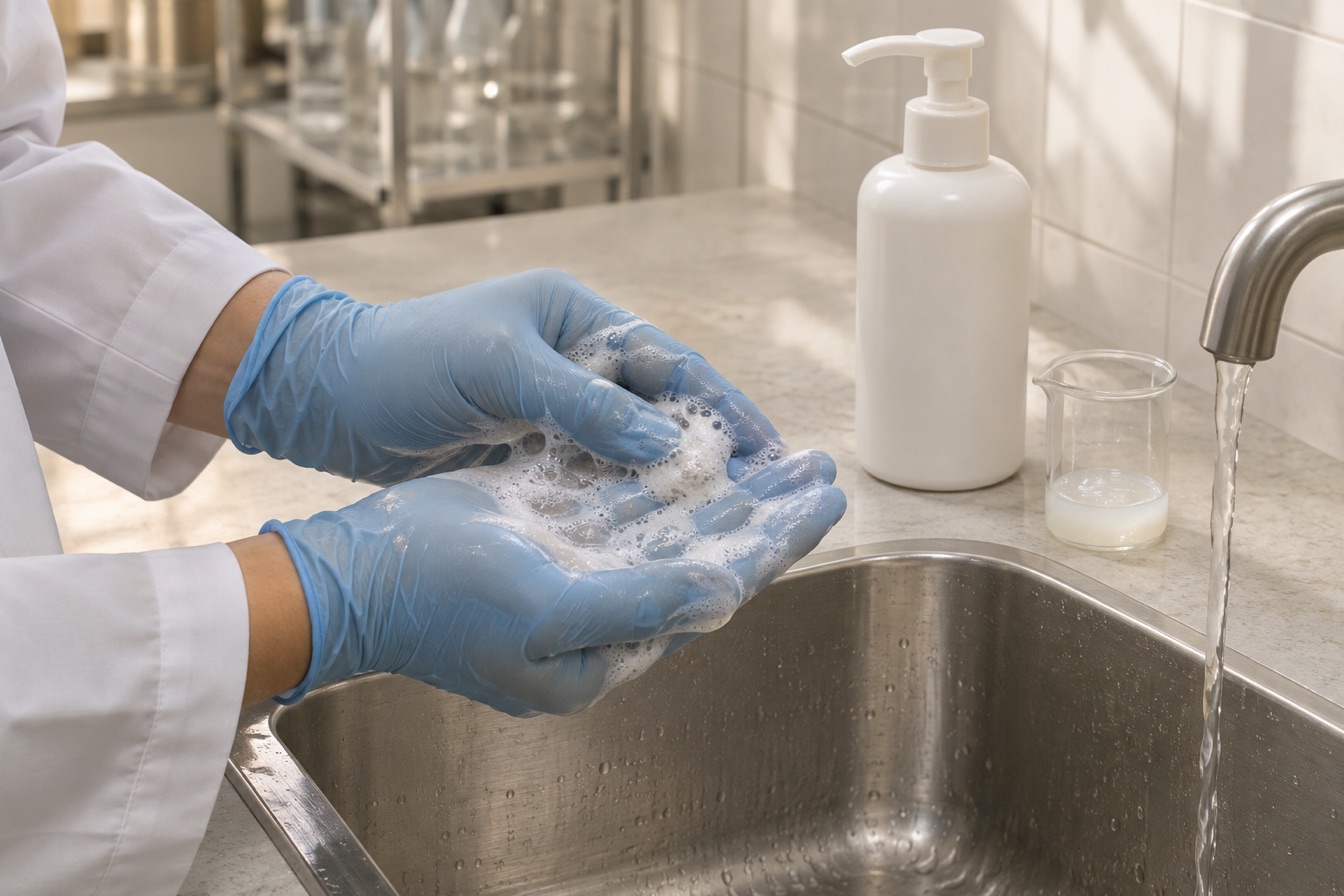
AI-generated image.
The short answer: settle fragrance, packaging and cleansing feel at the same time as the formula
Two shampoos or two body washes can look alike on a spec sheet and still feel like completely different products, because the difference sits in the scent, the bottle and the way they lather and rinse. These three choices are tied together. The fragrance changes what has to appear in the ingredient list, the bottle sets the viscosity window and often the real minimum order, and the cleansing feel is what you will judge samples against. Decide them in the brief, not after the first formula arrives, and the schedule slips less.
This guide is for brands outsourcing a rinse-off line such as shampoo and body wash for the first time. If you want a hair-loss claim on the shampoo, read our article on hair-loss claims for private-label shampoo. If you plan a body wash and a body lotion together, see how the rinse-off and leave-on split changes the formula.
The three decisions at a glance
- Fragrance: choose from a library or commission a new scent, and decide whether shampoo and body wash share one scent. Finish this before the ingredient list is locked.
- Packaging: pump or cap, fill size, and whether several products share one bottle. This is where viscosity and the minimum order get decided.
- Cleansing feel: describe lather, rinse and after-feel with a reference product and a use situation. This becomes the yardstick for samples.
When should the fragrance be decided?
Before the ingredient list is final. Some components inside a fragrance have to be named on the pack once they pass a set concentration, so a change of scent can change the ingredient list and the label copy with it.
For products sold in Korea, the rule is the Ministry of Food and Drug Safety notice on precautions for use and labelling of fragrance allergens (Notice No. 2026-56, in force 5 August 2026). Article 4 and Annex 2 list 25 fragrance allergens that must be named, including linalool, limonene, citral, geraniol and coumarin. The duty applies above 0.01% in rinse-off products such as shampoo and body wash, and above 0.001% in leave-on products. So the same fragrance faces a threshold ten times stricter if you later put it in a body lotion. If the line may grow into leave-on products, choose the scent with those products in mind from the start.
Three things to settle when you choose the fragrance:
- Library or new scent. Picking from an existing library makes comparison quick. For a new scent, the starting point is a direction: a reference scent, the ingredients it should evoke, or the moment it is meant for.
- One scent across the line, or one per product. If shampoo and body wash go out as a set, decide early whether they share a scent.
- Where you will sell. Each market sets its own allergen list and threshold. If you plan to export, name your target markets at the start and build a check of the fragrance's allergen content against each market's rules into the schedule.
How EVAS answers this: EVAS creates fragrances in-house. You can choose a scent from the EVAS fragrance library, or describe the scent you want and we will create and propose a new one. How we develop fragrance is set out on our custom fragrance page.
What should drive the choice of bottle?
Viscosity and minimum order quantity, not only looks. A pump has to be able to dispense the product without strain, and a flip-cap bottle or tube needs a flow that pours or squeezes the way you expect. If you change the container after the formula is nearly final, the formula-and-container check has to be repeated, so fix the format early in development. Our article on packaging compatibility covers when to lock the container.
The bottle is often what sets the real minimum. EVAS can produce from 1,000 units, but the actual minimum depends on the minimum order quantities of packaging components such as bottles, labels and printing. Packaging pricing usually becomes reasonable at around 10,000 units for bottles and tubes and 5,000 for labels. Those are typical efficient quantities, not minimums, and they vary with the component specification.
If you are launching shampoo and body wash together, one option worth a look is several products sharing one bottle, with a different label on each. For example, buy 10,000 of the same bottle in one order and 5,000 each of three labels (15,000 in total), then produce three products at 3,000, 3,000 and 4,000 units, so the total matches the bottle quantity. To share the same pump, though, all three formulas need a viscosity that suits it, so the products that will share a bottle are matched during formulation.
Containers where the design carries a lot of weight push the minimum up into steps of 10,000. To test small first, brands often choose from black-and-white stock (pre-molded) containers, which are priced higher per unit. Other ways to line up packaging quantities are on our small batch production page. Choosing a material and structure also brings packaging duties such as recyclability grade marks if you sell in Korea, covered in Korean packaging rules.
How do you brief the cleansing feel?
"Gentle" or "refreshing" means something different to every manufacturer. Give one reference product and the situation the product is used in, and you can compare samples on the same terms.
Points worth writing into the brief:
- Lather: how fast it builds, whether the foam is dense or loose, how long it lasts
- Rinse: whether the slippery feel should disappear quickly or linger slightly
- After-feel: for shampoo, tangling when wet and weight once dry; for body wash, tightness or a soft, moist feel
- Use situation: daily use or after the gym, and the hair or skin type of the main user
- Reference product: one product on the market close to what you want, plus "keep this, change that"
When samples arrive, use the same amount under the same conditions and note each point separately, so it is clear what the next round should change. Our guide to writing sample feedback shows how. Two notes for Korea: labelling a product for children brings extra documentation (children's products), and wording such as "low-irritation" needs evidence planned in advance (claim substantiation).
How EVAS answers this: EVAS manufactures hair care and body care products directly. Formula development usually takes 2 to 4 weeks, up to 12 weeks for specialty formulas, depending on the sample's difficulty. Production takes 8 weeks from the day packaging arrives; the time to make and deliver the packaging is not included. Our own-brand products and formula proposals by category are on the hair care and body care pages.
In what order should you decide?
- Products and line: shampoo only, a shampoo and body wash set, or a line that may grow into body lotion
- Markets and sales channels
- Fragrance: library or new scent, one scent across the line or not
- Packaging: format and fill size, and whether products share a bottle
- Cleansing feel: reference product and use situation
- Claims you want to make: functional or irritation-related wording, and the evidence behind it
Once 1 and 2 are clear, the options in 3 and 4 narrow, and 5 becomes the yardstick for samples. Claims in 6 change both the formula and the label, so don't leave them to the end. Our guide to writing a product brief walks through the brief, and development and production lead times covers the overall schedule.
FAQ
Can shampoo and body wash share the same fragrance?
Yes. Both are rinse-off products, so the same 0.01% allergen labelling threshold applies to both in Korea. If the same scent goes into a leave-on product such as body lotion, the threshold there becomes 0.001%, so tell us about any planned line extension when you choose the fragrance.
Can I start with just 1,000 units?
EVAS can produce from 1,000 units, but the actual quantity and cost per unit depend on packaging minimums for bottles and labels. One approach is to buy packaging at its minimum quantity up front and run production in batches of 1,000; the other is to buy packaging for 1,000 units at a higher component price. See our small batch production page and MOQ guide for details.
How much longer does a custom scent take?
The process and timing for a new scent are agreed in consultation once we know the scent you have in mind and the products it goes into. You are welcome to ask about both a library scent and a custom one in the same inquiry.
When you get in touch
Include the products and line, target quantities and fill sizes, the markets you will sell in, the scent direction and a reference product, and the first answer you get back will be specific. What to prepare is in our development guide, the scope of services is on our services page, and you can send your questions through the development inquiry.
Regulation checked: Korea Law Information Center, MFDS Notice No. 2026-56 on precautions for use and labelling of fragrance allergens in cosmetics (in force 5 August 2026), Article 4 and Annex 2, checked 25 November 2026. Information about EVAS reflects company confirmation as of 22 November 2026.