Short answer: the claim, not the ingredient, decides the route
In shampoo projects the sticking point is rarely the formulation. It is one sentence on the label. A general shampoo can be developed as an ordinary cosmetic in Korea, but to sell it with a claim of relieving hair-loss symptoms, the product has to be recognised as a functional cosmetic through a per-item review or a report.
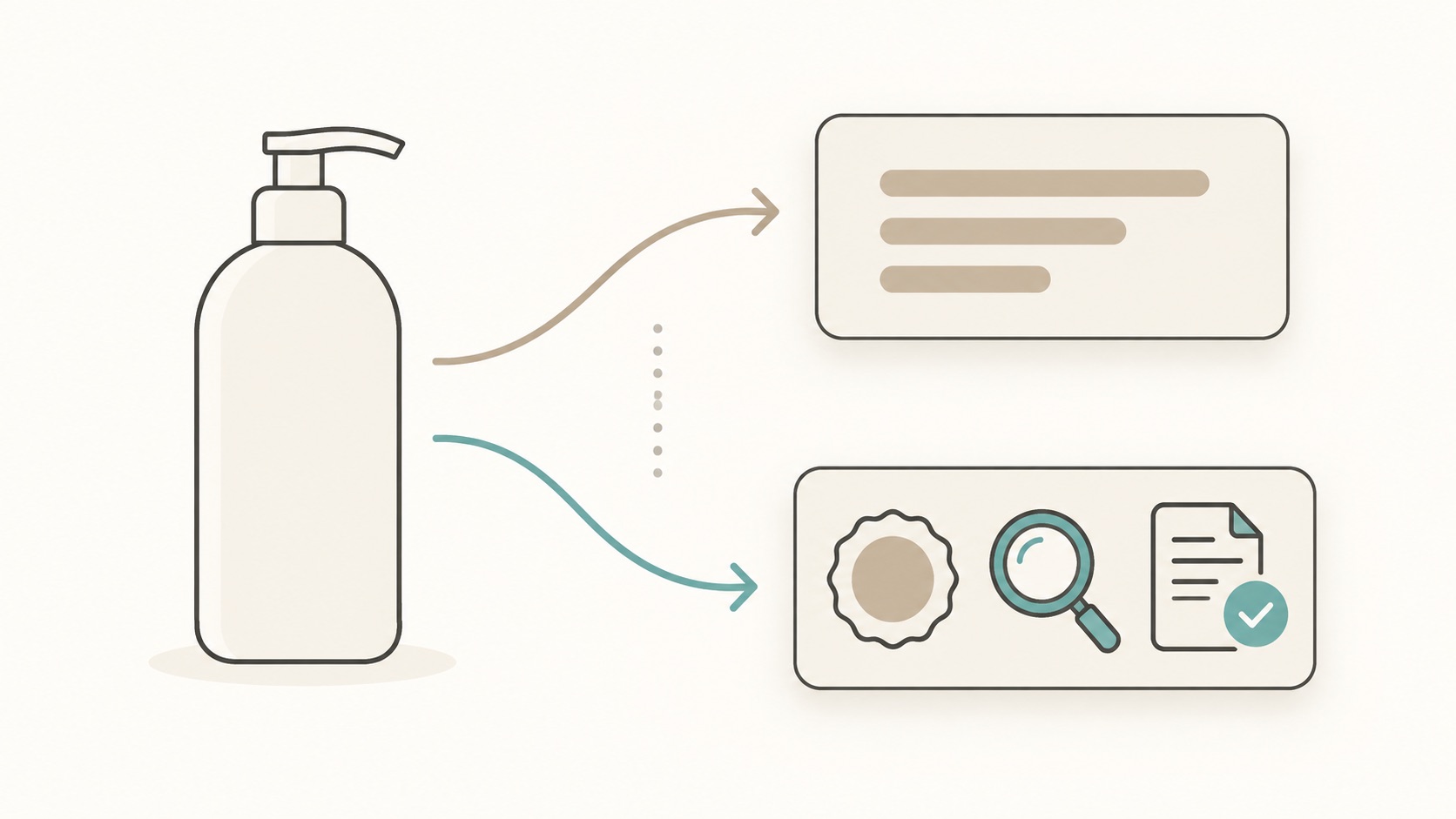
A concept illustration explaining how the claim splits the development route. It is not a photograph of an EVAS product, facility or review document.
1. What counts as a functional cosmetic
Article 2 of the Enforcement Rule of the Cosmetics Act lists 11 categories of functional cosmetics. Two of them concern hair products directly.
- Item 6: cosmetics that change hair colour, including bleaching and decolouring. Products that change hair colour only temporarily are excluded.
- Item 8: cosmetics that help relieve hair-loss symptoms. Products that merely make hair look thicker by physical means such as coating are excluded.
That exclusion in item 8 is the one teams most often miss. Even if the visible result is similar, a physical coating effect does not fall under this category.
For contrast, item 9 of the same article, cosmetics that help relieve acne-prone skin, is limited to personal cleansing products. It is not a category you can simply borrow for a scalp or hair concept.
2. Review or report
Article 4(1) of the Cosmetics Act requires a cosmetics manufacturer, a cosmetics responsible distributor, or a university or research institute prescribed by Ordinance of the Prime Minister that wants a product recognised and sold as a functional cosmetic to either undergo a review by the Minister of Food and Drug Safety or submit a report to the Minister, per item, regarding safety and efficacy. The same applies when changing a submitted report or a reviewed matter. Article 4(2) limits the efficacy review to the effects listed in the Act itself.
The Enforcement Rule splits the two routes.
- Report route: Article 10(1)1 covers a functional cosmetic whose type and content of the efficacy-producing ingredient, efficacy, dosage and administration, and specifications and test methods are the same as an item published by the Minister. Article 10(1)2 covers products for which the type, specification and content of the efficacy-producing raw material, the efficacy, the specifications and test methods, the dosage and administration and the dosage form are all the same as an already reviewed functional cosmetic. It also requires the same cosmetics manufacturer (only where the manufacturer designed, developed and produced the product), the same responsible distributor, or the same reviewed research institute. For the categories in Article 2 items 1 to 3 and 8 to 11, which include hair-loss relief, it applies only where the already reviewed item demonstrated efficacy against a control group. Article 10(1)3 adds a separate condition for combined items, so read the original text.
- Review route: Article 9(1) puts every functional cosmetic that is not a report case under per-item review, with the application form and the required attachments submitted to the President of the National Institute of Food and Drug Safety Evaluation. Its proviso allows items whose efficacy-producing ingredient and content the Minister has published to omit the data under subparagraphs 1 to 4, and items whose specifications and test methods have been published to omit the data under subparagraph 5.
For scheduling, the difference is significant. The report route works inside a framework that has already been published or reviewed. On the review route you first confirm which data waivers apply, then schedule the preparation of whatever remains.
3. Hair-loss claims are not on the Annex 4 blanket waiver list
Article 6(3) of the Regulation on the Review of Functional Cosmetics (MFDS Notice No. 2025-88, effective 16 December 2025) waives the data required under Article 4(1)(a) through (c) for items whose ingredient and content are published in Annex 4, the list of functional cosmetics exempt from data submission.
As of 16 September 2026, the Annex 4 file attached to that notice contains six groups.
- Products that help tan the skin evenly or protect the skin from ultraviolet rays
- Products that help whiten the skin
- Products that help improve skin wrinkles
- Products that change hair colour
- Products that remove body hair
- Products that help relieve acne-prone skin
Relief of hair-loss symptoms is not on that list. So a hair-loss-relief shampoo that does not meet the reporting conditions in Article 10 of the Enforcement Rule, or another waiver in Article 6 of this regulation, is safer to plan on the assumption of per-item review plus the data preparation it requires. Article 6 does contain other waivers separate from Annex 4, including the safety-data waiver in paragraph 1, the efficacy-test waiver in paragraph 2 and the previously reviewed item waiver in paragraph 4.
Article 4(1)(c) of the same regulation lists efficacy test data and human application test data as the evidence of efficacy or function, with a proviso that cosmetics under Article 2 item 6 of the Enforcement Rule, the hair-colour category, submit only hair-dye efficacy test data. Article 6(2) allows the efficacy test data to be waived when human application test data is submitted, but adds that the efficacy and effect of an ingredient whose efficacy test data was waived cannot be stated or labelled. What you submit determines what you are allowed to say.
The evidence requirements that end up applying can affect the timeline and the budget, which is why they belong in the brief rather than in a later meeting.
4. Ingredient limits are a separate question from the claim
Regardless of functional status, the limits in Annex 2 of the Regulation on Safety Standards for Cosmetics (MFDS Notice No. 2026-19, effective 18 March 2026), the list of ingredients subject to restricted use, still apply. Two limits come up constantly in hair products.
- Zinc pyrithione appears in the preservatives table at 0.5% in rinse-off products, prohibited in other products. It also appears separately in the other-ingredients table at a total of 1.0% as zinc pyrithione in rinse-off products that reduce dandruff and itching (shampoo, rinse) and in cosmetics that help relieve hair-loss symptoms, prohibited in other products. The same ingredient carries a different number depending on the purpose and the product type.
- Cetrimonium chloride and steartrimonium chloride are limited, singly or as the sum of a mixture, to 2.5% in rinse-off hair products and hair-dye products, and 1.0% in leave-on hair products and hair-dye products. The rinse-off shampoo and the leave-in treatment do not share a ceiling.
When you set a conditioning or anti-dandruff concept, these limits are the real boundary of formulation freedom.
5. What to settle in the brief first
- The final labelling and advertising sentence. Whether or not you use a functional claim decides the rest of the schedule.
- The product type. Rinse-off versus leave-on changes which ingredient limits apply.
- The assumed functional route. Review or report, and whether a human application study is planned.
- Priorities for fragrance, viscosity and foam. Sensory items only become comparable when written as criteria rather than preferences. See how to compare samples.
- When the container is locked. Packaging compatibility is better confirmed before the formulation is frozen.
- First order quantity and line-up. Small-batch planning and MOQ is a separate variable from functional status.
How to write the brief itself is covered in good product development starts with a clear brief.
6. Frequently asked questions
Is it enough to add a hair-loss ingredient? Adding an ingredient and advertising its effect are different questions. To sell a product on a hair-loss relief claim, it has to go through the review or report procedure for recognition as a functional cosmetic.
Are scalp care, volume and deep cleansing functional claims? The words scalp care, volume or deep cleansing do not by themselves settle the question. What matters is whether the claim as a whole conveys one of the effects listed in Article 2 of the Enforcement Rule, so each phrase needs its own check.
Does the same procedure apply to export products? Not necessarily. Everything above is based on Korean regulations for products sold in Korea. The Korean requirements that apply to export-only products, and the product classification and claim rules of the destination market, each have to be verified separately.
How long does an EVAS hair-loss functional shampoo take? It depends on the item and the state of the supporting data, so we do not publish generalised timelines or costs. Tell us the claim and the product type you have in mind and we will map the realistic routes first.
7. Next step
EVAS runs planning, design, research, manufacturing, logistics and brand content in-house. If you are preparing a shampoo or body care line, start with our development process and the formula library. Even before the claim direction is fixed, you can get in touch and we will work through which route is realistic. More articles are in insights.
8. Sources
Scope is the Republic of Korea. The statutes and notices below were read in the original on 16 September 2026. This article summarises published rules as general guidance; decisions on a specific product follow the latest original text and confirmation from the competent authority.
- Cosmetics Act of Korea, Article 4 (Review of Functional Cosmetics), effective 2 April 2026, Act No. 20901.
- Enforcement Rule of the Cosmetics Act of Korea, Articles 2, 9 and 10, effective 2 April 2026, Ordinance of the Prime Minister No. 2109.
- Regulation on the Review of Functional Cosmetics, Articles 4 and 6 and Annex 4, MFDS Notice No. 2025-88, effective 16 December 2025.
- Regulation on Safety Standards for Cosmetics, Annex 2 (Ingredients Subject to Restricted Use), MFDS Notice No. 2026-19, effective 18 March 2026.
Sources
- Cosmetics Act of Korea, Article 4 (Review of Functional Cosmetics), effective 2026-04-02, Act No. 20901 (Korea Law Information Center) (accessed 2026-09-16) ↗
- Enforcement Rule of the Cosmetics Act of Korea, Articles 2, 9 and 10, effective 2026-04-02, Ordinance of the Prime Minister No. 2109 (Korea Law Information Center) (accessed 2026-09-16) ↗
- Regulation on the Review of Functional Cosmetics, Articles 4 and 6 and Annex 4, MFDS Notice No. 2025-88, effective 2025-12-16 (Korea Law Information Center) (accessed 2026-09-16) ↗
- Regulation on Safety Standards for Cosmetics, Annex 2 (Ingredients Subject to Restricted Use), MFDS Notice No. 2026-19, effective 2026-03-18 (Korea Law Information Center) (accessed 2026-09-16) ↗